
Slow Realisation
Date:
May 23rd, 2026 - May 31st, 2026
Time:
5:30 AM - 2:30 PM
Location:
Triveni Gallery
Free Entry
EXHIBITIONS
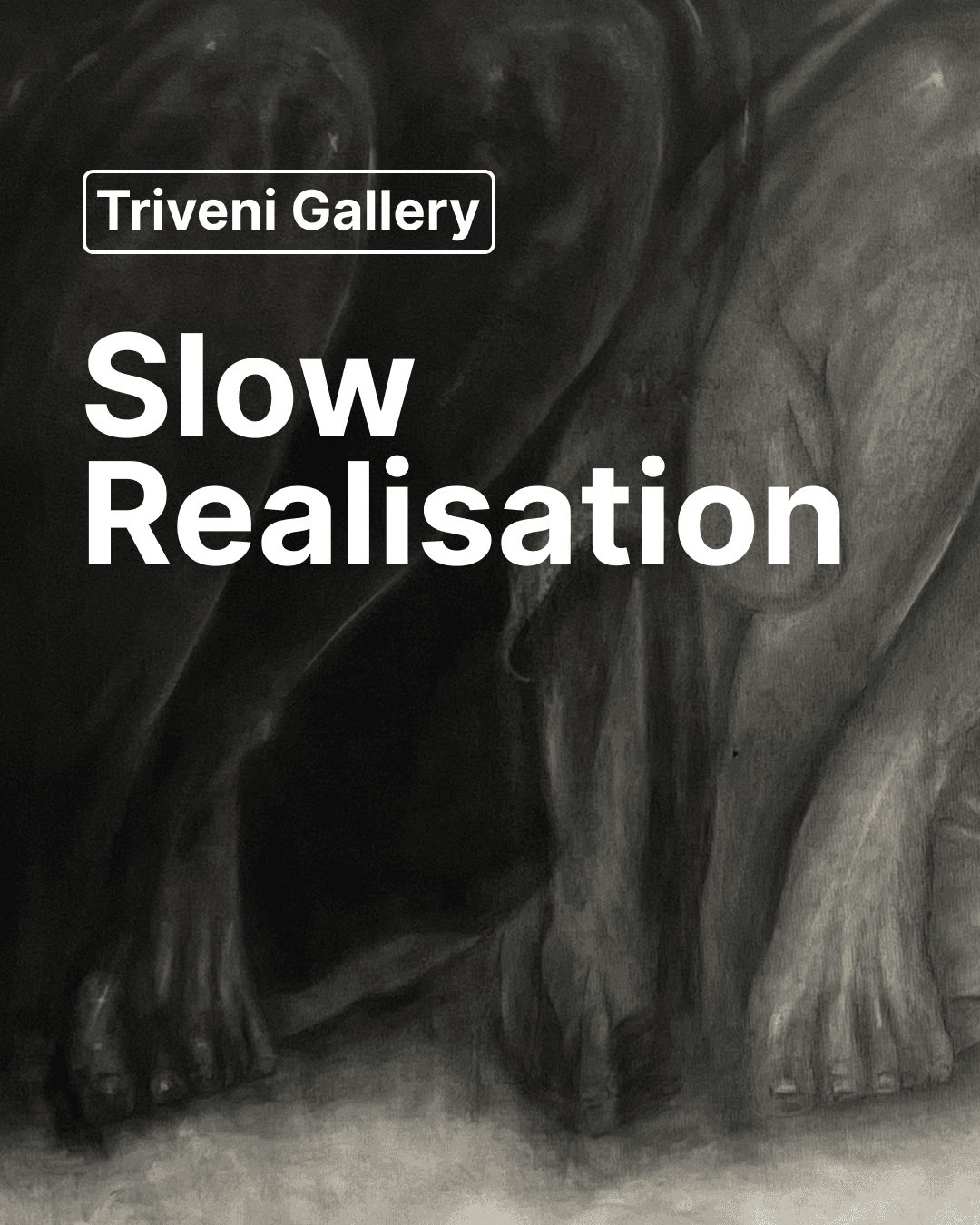
Sangam Peshawaria’s drawing practice belongs to a long artistic tradition that values fragments, partial views, and understated gestures as meaningful forms of expression. By focusing on overlooked bodily details—feet, hands, and subtle gestures—she shifts attention away from the conventional centrality of the face or torso, foregrounding instead the quiet language of the body’s margins. Her works encourage viewers to reconsider how identity and emotion can emerge through seemingly peripheral forms. This emphasis on bodily fragments recalls the expressive studies of Albrecht Dürer and the psychologically charged gestures of Egon Schiele. Yet Peshawaria’s drawings resist overt dramatization. Meaning unfolds through restraint, stillness, and repetition, allowing ordinary gestures to acquire emotional depth. Graphite plays a central role in this process. Its tonal range—from delicate greys to deep blacks—enables a close engagement with texture and surface. The medium also carries a sense of duration; its layered application reflects prolonged observation and careful attention. In this regard, her practice resonates with the disciplined draftsmanship of Jean-Auguste-Dominique Ingres and the introspective graphic works of Käthe Kollwitz. Fragmentation remains a defining aspect of her work. By withholding complete figures, Peshawaria invites viewers to reconstruct narrative and meaning. This strategy recalls the expressive partial forms of Auguste Rodin and the cropped compositions of Edgar Degas. Ultimately, her drawings resist spectacle in favor of attentiveness, revealing how quiet, everyday gestures can carry profound emotional and visual significance.

@triveni.kala.sangam
Fostering arts and culture since 1950.
Stay Connected
Be the first to know about upcoming exhibitions and performances.